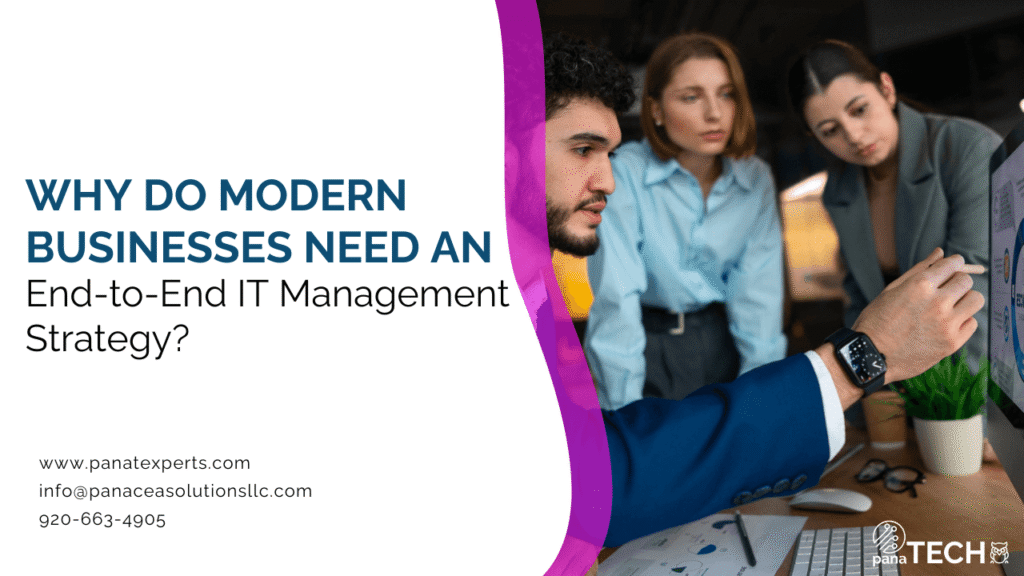
Today, many businesses focus on doing daily tasks & sales. Only few organizations work on how technology will help them grow. Without an efficient IT management strategy, businesses can face various kinds of technical issues. It may include system failures, security breaches, lost growth opportunities & rising costs. The risk of these issues grows when IT strategy is reactive not planned. An end-to-end IT management strategy is important to aligns advance technology with business goals, prevent from business disruptions, & stay competitive. Let’s uncover how a robust IT strategy help SMBs to grow in this digital landscape.
What Is End-to-End IT Management?
End-to-end IT (Information Technology) management means handling every part of a businesses’s technology lifecyle. It may include an effective IT planning 2026, infrastructure management, improving security, and regular performance tracking. It helps to ensures all IT systems are working properly and business running smoothly. This approach covers everything from technology policies, software, hardware to data and services for supporting a business. Strong IT management not only fixes problems but it plans, analysis and controls IT to drive success.
Why IT Strategy Is Important for SMBs?
Most SMBs treat IT management as a support system only. But this reactive approach can lead to unpredictable costs, missed oppertnunities and inefficiencies in business operations. Without a strategic IT planning, technology becomes a cost center rather than a asset. Strong IT management help small and medium size businesses with-
- Plan & control the budget of IT and resources
- Reduce downtime and business disruptions
- Align technology with business goals
- Enhance business security
- Improve customer service and operations with reliable systems
What Does an IT Management Strategy Include?
IT management strategy has several parts that work together to support business growth and security. The key components of a strong IT management strategy may include:
Business Alignment
Strategic business alignment ensures that your IT plans supports your company’s goals. When an expert IT and business teams share priorities, technology investments shows positive outcomes like more sales, better work efficiency and customer experience. This alignment ensures technology decisions are developed considering business needs, not just following trends.
IT Governance
IT governance establishes effective rules & accountability to make result-oriented technology decisions. It creates policies and controls to guide IT investments, compliance, and risk decisions. A governance framework enhances decision-making and ensures that IT supports the overall business strategy.
IT Infrastructure Management
IT infrastructure management handles the hardware, networks, servers, and systems that run the business. Smart IT management keeps all the systems running efficiently & reliably. This prevents outages that slow operations or cost revenue.
Data Management & Cybersecurity
Data is one of the most valuable business assets. A strategy must include rules for storing, protecting, and using data. Cybersecurity protects systems from breaches, ransomware, and leaks. With threats rising, businesses without strong data and security plans are at risk of costly attacks.
Resource & Financial Management
IT costs can grow fast without planning. A smart IT planning helps control budgets for software, hardware, staffing, & services. It also helps to ensure resources are employed where they provide the most value.
Risk Management & Business Continuity
Risk management identifies cyber threats that can disrupt a company. A strategic business continuity plan is important to prepare for outages, cyber attacks, disasters, so that operations resume quickly. Without IT management planning, organizations can risk long downtime which results in their lost reputation and revenue loss.
Performance Metrics (KPIs)
Key performance indicators (KPIs) helps to measure how well a IT management supports business goals. It helps businesses to see where improvement is required. Some of the important KPIs for SMBs includes-
- System uptime
- Helpdesk resolution times
- Project delivery quality
Innovation & Adaptability
Technology changes fast. A smart IT strategy includes planning and adapting new tools and trends. It helps companies to adopt innovations like cloud services, automation without disruption and more. A flexible IT plan helps businesses’s to stay competitive.
Why Every U.S. Business Needs an End-to-End IT Management Strategy?
In the U.S., technology drives almost all business operations today. Most companies use digital tools for sales, customer support, finance, marketing, and remote work. Without an IT management strategy:
- Costs become unpredictable
- Security gaps widen
- Business remains competitive
- Growth plan works
SMBs increasingly rely on technology. A recent survey represents many businesses now leveraging cloud tools, AI, and improved security to work smarter. But SMBs face challenges with ROI and costs. An end-to-end IT services help all size of businesses to adapt and scale according to market changes.
Key Benefits of an End-to-End IT Strategy
Here’s why every business requires robust managed IT services today-
Enhanced Security & Compliance
Strong IT plans involves strong security solutions with firewalls, monitoring, & training. It helps to reduce the risk of cyber crimes and legal fines. Managed IT service providers build enterprise-grade security plans even for small size businesses.
Improved Efficiency & Productivity
Proactive IT planning reduces disruption in business operations and prevents repeated technical problems. Giving less time to fixing IT problems means getting more time for productive work.
Cost Optimization
A strategic IT planning replaces unpredictable IT spending with planned budgets. A specialized managed IT services can save up to 20–40% on IT costs by preventing failures & optimizing assets.
Business Resilience & Continuity
With robust continuity plan, SMBs can recover faster from any outage or cyberattack. MSPs performs regular backup & disaster recovery tests to guard against data loss.
Strategic Alignment
IT management is directly tired with business goals. It not just supports tasks, but also helps to drive continuous growth and innovations.
Scalability & Agility
Tech needs changes as business grow. End-to-end IT planning ensures expansion is smooth and profitable. It helps to scale IT systems without causing any disruption or extra expense.
Clear Accountability
KPIs & well-defined governances makes roles and responsibilities clear for teams. Employees know what they have to deliver, and their performance can be measured regularly.
How Managed IT Services Help Businesses Build a Strong Strategy
Professional managed IT services help businesses in developing and maintaining a strategic IT plan in several effective ways. It may include:
Expertise and Strategic Alignment
Managed service providers bring deep technology knowledge. They help SMBs define a clear roadmap for IT investments. It helps align advance technology with business objectives.
Operational Efficiency and Risk Mitigation
MSPs monitor systems 24/ 7, prevent from problems, and reduce risk from outages or security threats. This proactive approach ensure a business run smoothly all the time.
Scalability & Focus on Core Competencies
Outsourcing a trusted managed IT company allows internal teams to focus on core business activities and achieving goals. This helps to enhance business productivity and adapt innovations.
Where to Get the Best Managed IT Services?
For businesses for strategic IT management support, panaTECH Experts offers specialized managed IT services tailored to organizations of al sizes. We provide an effecient IT planning, cybersecurity, cloud management, helpdesk support, and business continuity services. With several years of industry expertise and practical knowledge, we help SMBs lower costs, reduce risk, & stay competitive in this digital landscape.
Conclusion
Today’s business environment requires more than just reactive IT fixes. SMBs need a robust end-to-end IT management strategy to protect data and ensure growth. A strategic IT planning ties technology with business objectives and prepares companies for future growth. Contact panaTECH Experts to access expert support & strategic planning that make technology work for your business.
Frequently Asked Questions
Do small businesses need managed IT?
Yes. Outsourced managed IT services help small and medium-sized businesses access expert technology support without the overhead of building an in-house IT team. Managed IT helps reduce downtime, strengthen security, and ensure systems work efficiently.
How does IT planning save money?
IT planning saves money by preventing emergency costs, streamlining resources, and replacing unpredictable spending with planned IT investments. It also reduces waste caused by redundant tools and inefficient systems.
What are common IT management mistakes?
Common IT management mistakes include relying on reactive IT policies, ignoring cybersecurity risks, poor IT governance, and failing to align IT strategy with overall business goals.
How does IT planning reduce risk and downtime?
IT planning reduces risk and downtime through proactive monitoring, regular backups, and strong security measures. These practices help prevent system failures and ensure quick recovery when issues occur.